
For years, much of the global manufacturing conversation came down to a simple comparison: Asia or Mexico.
Today, for many U.S. manufacturers, the discussion has moved beyond that. Mexico may be a logical option for certain programs, but the harder question is how to enter the country without turning nearshoring into a slow, expensive, and difficult-to-stabilize operation.
That’s where the Build vs Partner debate starts to matter. Some companies want full control from day one. Others would rather move faster, reduce exposure, and validate their regional operation before committing major capital.
In practice, the difference between a smooth transition and a project full of operational friction rarely depends only on the country itself. More often, it comes down to the operating model. That’s why the Build vs Partner approach has gained traction across industries like plastic injection molding, specialized manufacturing, technical components, and production for the North American market.
Moving manufacturing today is not just about finding lower labor costs. It’s also about reducing uncertainty, responding faster to market changes, and preventing the supply chain from becoming too rigid.
The new reality of nearshoring to Mexico
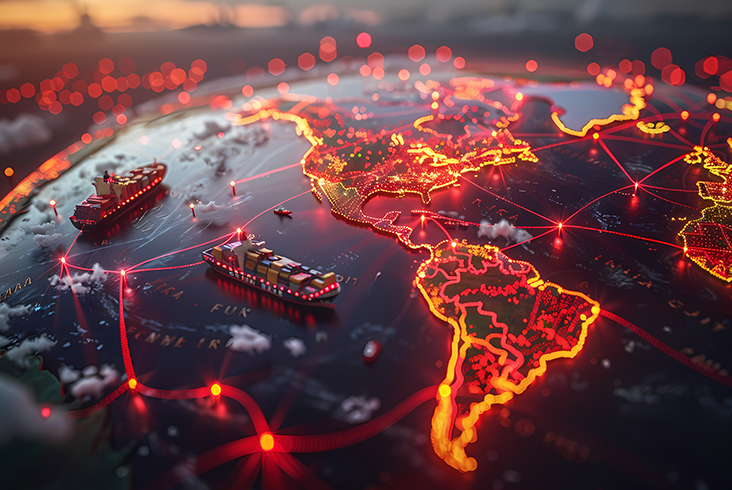
Mexico continues to strengthen its position as one of the most important manufacturing destinations for the U.S. market. Geographic proximity, the USMCA, and deeper logistics integration with North America have accelerated many industrial relocation projects.
But once companies move from executive presentations to real operational execution, the conversation changes.
Nearshoring is not simply about relocating production from one country to another. In practice, it forces companies to rethink:
- delivery times
- inventory strategy
- logistics costs
- quality control
- operational communication
- responsiveness to engineering changes
It’s common to see companies initially evaluate Mexico as a cost-saving alternative, only to later prioritize entirely different variables: reacting faster to demand shifts, reducing safety stock, or gaining more visibility into production.
That shift has changed how many manufacturers make operational decisions.
The Real Cost of Uncertainty
Asia still offers real advantages: massive manufacturing capacity, mature industrial ecosystems, and competitive pricing across many sectors. The issue is that the global environment is no longer as predictable as it once was.
Today, many manufacturers are more concerned about operational stability than finding the lowest unit cost.
A plastic component sourced from Asia may look highly competitive on paper. But the real cost changes once long lead times, excess inventory, delayed validations, slow engineering updates, or heavy reliance on ocean freight start affecting the program.
The problem usually doesn’t appear in the original quote.
It appears later.
When a customer changes a specification and the adjustment takes weeks. When a mold requires corrections and coordination slows down. When inventory sitting in transit starts affecting cash flow, floor space, and production planning.
For many industrial buyers, the question is no longer just how much it costs to manufacture a part.
Now it’s also about how much it costs to lose flexibility.
The new dilemma: Build your own operation or work with a manufacturing partner
As more companies look at manufacturing in Mexico, a difficult question starts to surface:
Should they build their own operation from scratch or work with an established manufacturer?
Both models can work. But they don’t carry the same level of risk, speed, or operational complexity. That difference becomes especially important for mid-sized companies, new programs, or projects that are still adjusting volumes.
What building your own operation really means
On paper, opening your own facility sounds attractive. It offers greater control, custom infrastructure, and full ownership of the process.
In reality, building a manufacturing operation in Mexico involves far more than leasing a building and purchasing equipment.
Very early on, companies run into issues that often receive less attention than they should:
- technical hiring
- permits and compliance
- supplier validation
- labor stability
- logistics integration
- quality systems
- maintenance
- documentation control
- customs management
One of the most underestimated factors is the operational learning curve.
A new facility may have modern equipment and solid infrastructure, but that does not mean operations will stabilize quickly. Experience is built through actual production cycles, process adjustments, scrap reduction, validations, and time.
That learning process has a cost, even if it doesn’t show up clearly in the original budget.
The Risks That Show Up After Launch
Many companies calculate initial CAPEX reasonably well. What often grows later are the operational costs.
It’s not unusual to install equipment on schedule and then spend months building a stable technical team.
The same thing happens with tooling. The mold may arrive correctly, but process validation can still take additional months due to dimensional deviations, repeatability issues, or unexpected adjustments.
As production volume increases, other problems start appearing:
- quality variation between shifts
- incomplete documentation
- inconsistent local suppliers
- reactive maintenance
- mold transfers with insufficient technical information
That’s usually when the project starts consuming time nobody accounted for during quoting.
Even companies with international experience run into friction when trying to replicate operations in a new environment. That’s why many manufacturers are reevaluating whether they truly need to build the entire structure from day one.
What working with a manufacturing partner really means
In some industrial sectors, there’s still a perception that working with a manufacturing partner simply means outsourcing production.
In reality, modern contract manufacturing is far more operational and strategic than that.
A strong manufacturing partner provides more than installed capacity. It also brings local experience, stabilized processes, technical support, trained personnel, supplier networks, and a shorter learning curve.
That changes the equation significantly.
Instead of spending years building internal infrastructure before production even starts, many companies choose a more flexible approach — especially when the program is still growing, demand is uncertain, the product requires validation, or engineering changes are frequent.
Buying speed is also a strategy
Many companies evaluate the partner model only from a financial perspective.
But in manufacturing, speed has value too.
An established manufacturer can significantly reduce the time between strategic approval and actual production launch.
For a company trying to validate a program for North America, waiting two years before producing anything may simply be unrealistic.
In those situations, working with a partner helps reduce exposure while the program gains technical and commercial clarity.
Build vs Partner: The difference is not just cost
Many Build vs Partner comparisons focus heavily on direct costs. But that leaves out variables that often have a much bigger operational impact:
- implementation speed
- operational stability
- flexibility
- responsiveness
- hidden costs
- administrative complexity
- supply chain stability
Ramp-Up time
Building your own operation can take anywhere from 12 to 36 months depending on complexity.
And it’s not just about construction.
Companies also need to consider hiring, equipment installation, certifications, process validation, operational integration, and production stabilization.
An established manufacturer can usually reduce those timelines substantially, especially when infrastructure already exists and the focus is concentrated on tooling, validation, and launch.
Operational risk
When a company builds its own operation, it absorbs nearly all of the initial operational complexity: staffing, quality, maintenance, logistics, compliance, and day-to-day production management.
Some companies have the structure to handle that.
Many realize the operational burden is much heavier than expected.
A manufacturing partner helps reduce that load. The customer still maintains strategic oversight, but avoids building the entire operation while the project is still maturing.
Flexibility and scalability
Flexibility has also become a critical factor.
Many companies are still trying to understand how their North American demand will evolve. In those situations, opening a full-scale facility too early can create excess capacity or costs that are difficult to justify.
Working with a specialized manufacturer allows companies to adjust:
- production volumes
- programs
- engineering changes
- manufacturing capacity
without redesigning the entire operational structure.
The tooling factor: Why Asia still matters

One of the most common mistakes in nearshoring is assuming that moving production to Mexico means eliminating Asia entirely from the supply chain.
In reality, many companies are building more hybrid operating models — especially when it comes to tooling.
China still maintains highly specialized mold manufacturing ecosystems with deep technical experience, mature supplier networks, competitive pricing, and strong capabilities for complex tooling projects.
Trying to replace that infrastructure completely does not always make operational sense.
The Problem Is Not Asia. The Problem Is Depending Entirely on Asia
Many companies do not need to remove all operations from Asia.
What they actually want is lower exposure, better responsiveness, and fewer operational bottlenecks.
That’s why hybrid models are becoming increasingly common. In these structures, offshore tooling and certain specialized processes remain in Asia, while production, validation, and operational response move closer to North America.
A point many companies discover too late is that moving manufacturing is not simply about changing countries.
It also means coordinating suppliers, validating tooling, managing quality, securing raw materials, supervising production, and building reliable operational relationships.
And usually, all of that complexity ends up falling on the customer.
That’s why many manufacturers are looking for partners capable of managing the entire operation instead of forcing them to build the regional infrastructure themselves.
This approach allows companies to combine:
- competitive tooling in Asia
- production in Mexico
- shorter lead times to the U.S.
- faster response to engineering changes
- lower dependence on ocean freight
- closer operational support
In many programs, the goal is not to abandon Asia.
It’s to stop depending entirely on it.
Why specialized manufacturing requires more than installed capacity
In industrial manufacturing, not all parts carry the same level of complexity.
Some components look simple on a drawing but create constant production issues once manufacturing begins.
Small deviations can lead to:
- flash
- short shots
- warpage
- cavity-to-cavity variation
- excessive scrap
- dimensional issues
- assembly failures
That’s why selecting a manufacturer based only on price usually ends badly in technical programs, especially when tight tolerances or sensitive production volumes are involved.
In those situations, process experience matters just as much as production capacity.
Micro molding is not just “Small Injection Molding”
Micro molding presents a completely different set of challenges compared to conventional injection molding.
When parts become extremely small, the process window narrows significantly.
Variables like temperature, pressure, humidity, resin viscosity, tooling precision, and repeatability have a much larger impact.
At that scale, even a minor variation can affect an entire production run.
That’s why companies working with technical components tend to look for partners with specific micro molding experience and far tighter process control.
When building makes sense — And when partnering Is smarter
There is no universal answer.
Building your own operation can make sense for high-volume programs, long-term manufacturing strategies, highly specific vertical integration requirements, or situations that demand extreme internal control.
Partnering is often more practical and financially reasonable in other scenarios:
- mid-sized industrial companies
- new programs
- market validation stages
- medium production volumes
- projects with frequent engineering changes
- specialized technical components
In practice, many companies prefer to start with a flexible model, better understand the regional operation, and then decide whether expansion makes sense later.
For many U.S. manufacturers, that flexibility has become more valuable than immediate ownership of a facility.
How Drimo Plastics helps reduce manufacturing risk for North America
In this environment, many companies are no longer looking for a simple supplier.
They are looking for a manufacturing partner capable of reducing operational complexity and accelerating the transition toward regional manufacturing.
That is exactly where Drimo Plastics operates.
From its production facility in Querétaro, Mexico, Drimo supports companies that need manufacturing closer to the U.S. market without absorbing the full operational burden of building an operation from scratch.
At the same time, Drimo Plastics maintains strategic partnerships with suppliers and manufacturing partners in China for projects where offshore tooling or specialized processes still provide strong technical and economic advantages.
The logic behind this model is not to replace Asia completely.
It is to integrate the strengths of both regions under a simpler operational structure for the customer.
Our approach combines:
- plastic injection molding
- micro molding
- technical support
- tooling
- manufacturing coordination
- project supervision
all with a focus on operational stability and regional supply chain performance.
For many U.S. companies, this helps avoid a very common problem: having to build and coordinate the entire operational network on their own.
Finding suppliers. Validating tooling. Coordinating offshore production. Hiring technical personnel. Managing quality. Solving logistics issues. Supervising transfers.
All of that consumes time, resources, and operational bandwidth.
The role of a strategic partner like Drimo Plastics is to reduce that complexity.
Manufacturing in Mexico with an operational mindset
Mexico offers major advantages for North American manufacturing, but geographic proximity alone does not solve operational problems.
Execution is usually where the real difference appears.
Drimo participates in programs where engineering changes are frequent, speed matters, quality stability is critical, tooling requires close follow-up, and operational flexibility is necessary.
Those types of programs require more than simply producing parts.
Supervised offshore tooling and production close to the end Market
One of the models generating the most interest today combines Asian tooling with production in Mexico.
Drimo helps coordinate that process to reduce friction between development, validation, and production.
This model allows companies to leverage competitive offshore tooling while keeping production closer to North America, reducing lead times, simplifying maintenance and engineering updates, and lowering logistics exposure.
For many manufacturers, it creates a more stable operational balance.
Micro molding and specialized technical manufacturing
Drimo’s micro molding capability is especially relevant for programs where repeatability and dimensional control are critical.
Producing parts between 0.01 and 1 gram requires:
- precise process control
- high-precision tooling
- constant validation
- operational stability
In these types of programs, technical experience usually matters far more than simply finding the lowest quote.
The smartest decision Is not always building first
For years, many companies assumed that opening their own facility was the natural next step in nearshoring.
Today, the market is moving toward more flexible operating models — models where part of the supply chain remains global, production moves closer to the end market, tooling is optimized strategically, and operational risk is distributed more intelligently.
In that environment, working with a manufacturing partner can be far more efficient than building infrastructure too early.
At the end of the day, the goal is not to accumulate assets.
It’s to build an operation that is stable, flexible, and capable of responding quickly when the market changes.
FAQ
Is it better to open a manufacturing facility in Mexico or work with a manufacturing partner?
It depends on production volume, investment horizon, and required control level. Many mid-sized manufacturers prefer starting with a partner to reduce operational risk, accelerate ramp-up, and validate demand before investing in their own infrastructure.
How long does it take to start manufacturing in Mexico?
Building your own operation can take between 12 and 36 months depending on complexity. Working with an established manufacturer usually shortens that timeline significantly.
What are the most common hidden costs of building your own operation?
The most common include technical hiring, process validation, regulatory compliance, logistics integration, maintenance, training, and early operational stability issues.
Why do many companies still build molds in Asia?
Because Asia still maintains highly specialized tooling and precision mold manufacturing ecosystems with strong technical capabilities and competitive costs for many projects.
Can tooling be manufactured in Asia while production happens in Mexico?
Yes. Many companies use hybrid models where tooling is developed offshore while production moves closer to North America to reduce lead times and improve responsiveness.
What types of companies benefit most from working with a manufacturing partner?
Mostly mid-sized industrial companies, new programs, businesses with variable demand, and manufacturers looking to accelerate market entry without taking on a full operational investment.
What makes micro molding more complex?
Micro molding requires much tighter process windows, high-precision tooling, and greater operational stability due to the extremely small size of the components.