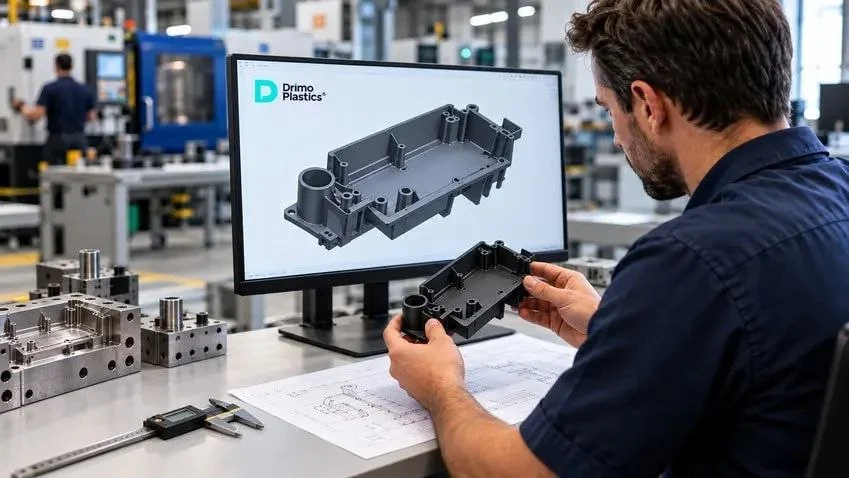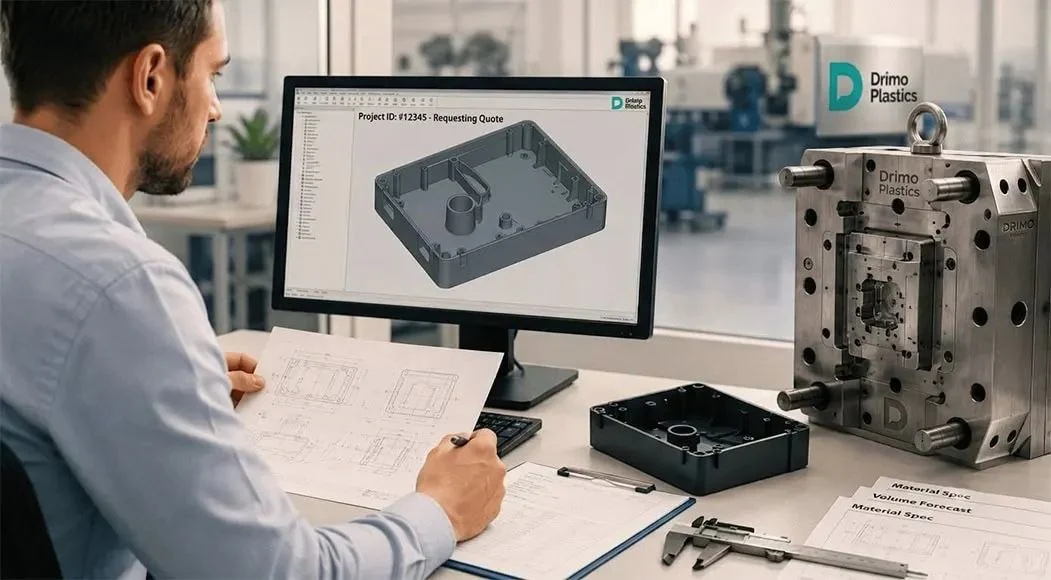
Requesting a plastic injection molding quote is easier when you know what information helps the manufacturer understand your project. It is not simply a matter of describing the part you want to manufacture; you also need to share the details required to evaluate the design, material, mold, volume, timing, and actual production conditions.
This article explains what information to gather before requesting a quote, how each detail affects pricing, and what a specialized supplier such as DRIMO Plastics evaluates before preparing a technical and commercial proposal.
You Do Not Need a Perfect RFQ Before Contacting a Supplier
In manufacturing, RFQ stands for Request for Quote. It is the set of technical and commercial information that allows a manufacturer to analyze a project and prepare a proposal.
An ideal RFQ may include 3D files, 2D drawings, material specifications, annual volumes, key dates, quality requirements, packaging, logistics, and target pricing. In practice, however, many projects begin before all of these elements have been defined.
Some customers come to us with complete technical information. Others start with a physical sample, a sketch, a part they want to replicate, or a product idea that still requires development.
The key point is this: the more information you can provide, the faster and more accurate the quote will be; however, you do not need a perfect RFQ to start the conversation.
In fact, speaking with a supplier early in the process can help you make better decisions before investing in the final design, tooling, or production. Factors such as material, part geometry, the number of mold cavities, and estimated volume can significantly affect project cost and feasibility.
Every Plastic Injection Molding Project Starts at a Different Stage
The starting point depends on the product’s stage of development, the customer’s experience, and the type of part to be manufactured. The quoting process should therefore adapt to the information available and the project’s level of maturity.
When the customer already has complete technical information
An advanced project typically includes CAD files, 2D drawings, a specified material, estimated volumes, packaging requirements, quality specifications, and key production dates.
With this information, the supplier can analyze part geometry, review tolerances, evaluate the material type, and estimate the manufacturing concept more accurately.
In these cases, the quote can focus more quickly on items such as:
- mold or tooling investment;
- price per part
- lead time
- number of cavities
- production capacity
- potential design optimizations
- logistics and packaging requirements.
Even when a project is well advanced, a technical review can uncover opportunities for improvement. Adjustments to wall thicknesses, radii, material, or design can make the injection molding process easier and help prevent downstream costs.
When the customer only has a sample, sketch, or idea
Some projects also begin with more limited information. For example, a company may have a physical part it wants to replicate, a component that needs improvement, a plastic housing for a new product, or a functional need that has not yet been converted into drawings.
In these cases, the process may include reverse engineering, 2D and 3D drawing development, material selection, a design-for-manufacturability review, mold design, and prototype production.
This type of support is valuable when the customer needs to turn an initial reference into a product that is viable for manufacturing. The supplier’s role is not limited to quoting the project; it also includes helping structure it from a technical standpoint.
Information That Helps Produce a More Accurate Quote
A plastic injection molding quote does not depend on a single data point. Final pricing is tied to part geometry, material, mold design, volume, cycle time, quality requirements, and other production factors.
The following table summarizes the information that is most helpful when requesting a quote.
| Information | Why It Matters |
| 3D files, preferably STEP | Allow the team to analyze geometry, wall thicknesses, technical details, and manufacturing feasibility. |
| 2D drawings | Help review dimensions, tolerances, finishes, and critical specifications. |
| Physical sample | Useful when digital files are unavailable or when the goal is to replicate, evaluate, or improve an existing part. |
| Product application | Clarifies the end use, operating conditions, mechanical loads, temperature, environment, and functional requirements. |
| Required material | Affects strength, flexibility, appearance, durability, cost, and behavior during the injection molding process. |
| Annual and total volume | Helps define the mold concept, number of cavities, machinery, automation, and price per part. |
| Key dates, such as SOP and EOP | Support planning for the production launch, project duration, and development lead times. |
| Target budget | Helps align the technical solution with expectations for mold investment and price per part. |
| Additional requirements | Include packaging, logistics, assembly, finishes, secondary operations, or special delivery conditions. |
Each detail reduces assumptions. For example, knowing the annual volume helps determine whether a single-cavity or multi-cavity mold makes sense. Understanding the product application supports appropriate material selection. Knowing the SOP and EOP dates makes it possible to plan development, mold manufacturing, and the production launch.
3D Files, Drawings, or Physical Samples: What Can You Send?
Technical information can be provided in several forms. Not every resource serves the same purpose, so it is useful to understand what each one contributes.
3D files
3D files make it possible to review the part’s actual shape. For industrial projects, .STEP, .STP, or .IGES formats are generally preferred because they preserve solid geometry or editable surfaces. This facilitates design-for-manufacturability analysis and prevents delays during the technical review.
By contrast, an .STL file typically contains a triangular mesh rather than clean parametric geometry. It can be useful for 3D printing or visualization, but it is not the ideal format for quoting an injection-molded part. When only an STL file is available, the team often has to reconstruct or reinterpret the geometry before moving forward, which can slow down the quoting process.
With a 3D file, the technical team can evaluate wall thicknesses, radii, draft angles, critical areas, potential warpage, gate locations, and overall moldability.
In practice, wall thickness is one of the first features reviewed. There is no universal specification because the appropriate thickness depends on the material, part size, mold, machine, and end-use application. However, maintaining appropriate and consistent wall thicknesses helps reduce risks such as sink marks, visible defects, warpage, uneven cooling, and filling difficulties.
Another key factor is the draft angle. This feature allows the part to be ejected correctly from the mold without sticking, marking, or damage. The required angle varies according to the geometry, material, texture, surface finish, and mold concept, which is why it should be reviewed during the design stage.
These details may seem minor during design, but they make a major difference on the production floor. A completely vertical wall, an undercut area, or a texture that was not properly considered may require a design change before the mold can be manufactured.
2D drawings
2D drawings complement the 3D model by showing details that are not always clear from the digital geometry. They are especially important when a part has critical dimensions, specific tolerances, surface finishes, quality notes, or assembly requirements.
A part may appear visually simple yet include a functional area that requires high precision. In that case, the 2D drawing helps identify which dimensions must be held tightly and which could potentially be optimized to simplify manufacturing.
Drawings are also useful when the part belongs to a larger assembly because they show how it interfaces with other components. For example, a cover, clip, housing, or internal receptacle may require different tolerances depending on its actual function.
Physical samples
A physical sample can provide valuable information when complete digital files are unavailable. It allows the team to observe size, shape, finish, assembly, function, wear, possible materials, and in-use characteristics.
It can also serve as the basis for reverse engineering, especially when the goal is to replicate an existing part, improve a component, replace a supplier, or transfer manufacturing to Mexico.
In some cases, a physical sample reveals details that do not always appear on a drawing, such as wear patterns, stress areas, fit issues, or real-world functional needs.
Production Data That Affects the Quote
The cost of an injection-molded part does not depend on size alone. Two visually similar parts can receive very different quotes if one requires a specialty material, tighter tolerances, a longer cycle time, individual packaging, downstream assembly, or low-volume production.
The primary factors that affect a quote include:
- annual production volume
- total lifetime project volume
- part size and weight
- required plastic resin
- geometric complexity
- number of mold cavities
- estimated cycle time
- level of automation
- quality requirements
- packaging type
- logistics
- secondary operations or assembly.
Volume is one of the most important factors. Producing thousands of parts per year is very different from producing millions. Higher volume may justify a more robust mold, additional cavities, or a higher level of automation. Each of these decisions affects both the upfront investment and the price per part.
Material also has a direct impact. Some plastics are more economical and easier to process, while others provide greater mechanical strength, dimensional stability, thermal performance, rigidity, flexibility, or other specialized properties. Selecting the right material affects cost as well as product durability and performance.
Geometric complexity is another key consideration. Features such as threads, inserts, thin walls, cosmetic surfaces, assembly features, or tight tolerances can change the mold concept and manufacturing process.
What Does DRIMO Plastics Evaluate Before Preparing a Proposal?
Before preparing a proposal, the technical team needs to understand the project as a whole. A strong quote does more than calculate the cost of producing a part; it also considers which manufacturing solution makes the most sense.
During an initial evaluation, DRIMO Plastics may review factors such as:
- part geometry
- manufacturing capabilities
- required material or expected properties
- mold concept
- number of cavities
- required machine size
- estimated cycle time
- level of automation
- manufacturing location
- production costs
- quality requirements
- potential design optimizations.
Based on this analysis, the team can define a proposal that addresses the tooling or mold investment, price per part, lead time, and recommended manufacturing concept.
This review also helps identify technical risks before the project moves forward. Examples include excessive variation in wall thickness, hard-to-fill areas, materials that are poorly suited to the application, unnecessarily tight tolerances, or design decisions that could increase mold costs.
The purpose of this evaluation is to find the right balance among performance, cost, quality, and production capacity.
Support Services That Can Help Before Production
DRIMO Plastics can support customers with services related to:
- product development
- design optimization
- material selection
- reverse engineering
- 2D and 3D drawings
- tool or mold design and manufacturing
- prototype production
- production transfers from Asia to Mexico
- serial production in Mexico.
These services are especially useful when a project needs to move from an initial reference to a manufacturable part. They can also add value when a company wants to improve an existing part, reduce costs, change suppliers, or manufacture in Mexico to bring production closer to the North American market.
On many projects, decisions made before production have a direct impact on the final outcome. A well-designed part can simplify molding, improve quality, reduce scrap, and prevent rework. A poor early decision can lead to costly changes after the mold has been manufactured.
Why Early Supplier Involvement Can Reduce Cost and Lead Time
Involving the manufacturer early makes it possible to review the design, material, and manufacturing concept before investing in tooling. This can prevent later engineering changes, which are generally slower and more expensive once the mold has already been built.
An early technical review can help:
- improve the part design
- prevent errors before mold manufacturing
- select a more appropriate material
- optimize the mold concept
- determine the appropriate number of cavities
- reduce rework
- improve production costs
- plan serial production more effectively.
- anticipate packaging, logistics, or assembly requirements.
This is especially important for new projects. When design, material, mold, and volume are evaluated together, it is easier to strike a balance among functionality, cost, and production feasibility.
3 Common Mistakes We See When Quoting Plastic Injection Molding Projects
1. Selecting a resin based on cost rather than function
One of the most common mistakes is choosing the least expensive plastic without considering how the part will actually be used. In plastic injection molding, material should not be selected on price alone. Mechanical loads, operating temperature, UV exposure, chemical contact, rigidity, flexibility, appearance, and durability must also be evaluated.
A seemingly economical resin can ultimately cause performance problems, warpage, premature failure, or later adjustments to the design and process. In many cases, the true cost is not limited to the price per kilogram of material; it includes what happens when the part fails to perform as intended.
2. Ignoring draft angles in the initial design
It is also common to receive models with completely vertical walls or areas that make part ejection difficult. The design may look correct on screen, yet the same geometry can cause marks, friction, sticking, or a redesign once it reaches the mold.
Reviewing draft angles from the outset therefore helps prevent delays. A part intended for injection molding must be designed with consideration for how the plastic will enter, cool, and exit the mold. The design must do more than look right: it must be manufacturable through a repeatable process.
3. Failing to consider packaging or secondary operations
Some projects are quoted with only the injection-molded part in mind, but additional needs may emerge later: assembly, threaded inserts, finishing, printing, inspection, individual packaging, labeling, or special transportation conditions.
These elements can change both cost and production flow, so it is best to mention them from the beginning. Delivering bulk parts is not the same as delivering assembled, protected components that are ready to enter the customer’s supply chain.
Checklist Before Requesting Your Quote
Before contacting DRIMO Plastics, you can use this checklist to organize the available information and streamline the project review.
- 3D file, preferably in STEP format.
- 2D drawing, if available.
- Physical sample or photographs of the part.
- Description of the product’s end use.
- Part operating conditions.
- Desired material or required properties.
- Estimated annual volume.
- Total project volume.
- Target production start date.
- Estimated production end date.
- Target budget for the mold or part, if available.
- Packaging requirements.
- Logistics requirements.
- Assembly needs.
- Finishes or secondary operations.
- Delivery city or country.
- Whether the project is new, existing, or a production transfer.
This list also makes it easier to compare proposals from different suppliers because it provides a clearer technical basis for evaluating each quote.
Frequently Asked Questions About Plastic Injection Molding Quotes
Can I request a quote if I only have an idea?
Yes. In that case, the first step is usually to review the concept, product application, functional requirements, and development alternatives needed to turn the idea into a manufacturable part.
Do I need to have a mold before contacting DRIMO?
Not necessarily. Some customers already have an existing mold, while others need to develop one from scratch. DRIMO can support tool or mold design and manufacturing based on the project’s needs.
Which file format should I send?
When available, a 3D file in STEP, .STEP, or .STP format is generally a good option for analyzing part geometry. .IGES files may also be used. STL files can serve as a visual reference, but they are not ideal for quoting because they contain polygon meshes rather than editable solid geometry.
What if I do not know which material to use?
You can share the part’s end use, operating conditions, and required properties, such as strength, flexibility, appearance, temperature resistance, or durability. With this information, the technical team can guide the material selection process.
Does production volume affect the quote?
Yes. Volume influences the mold concept, number of cavities, level of automation, price per part, and upfront investment. It is therefore helpful to share both the annual volume and the total expected volume over the project life cycle.
Can DRIMO manufacture in Mexico for international companies?
Yes. DRIMO Plastics supports projects for local and international companies seeking to manufacture plastic parts in Mexico, including companies interested in bringing production closer to the North American market.
What information helps produce a more accurate quote?
The most useful information includes 3D files, 2D drawings, a physical sample, product application, material, volumes, key dates, target pricing, and additional requirements such as packaging, logistics, or assembly.