Two plastic parts may look alike but require very different investments. One might use a simple mold, while the other needs special mechanisms, a specific resin, or more demanding inspection.
That is why there is no universal price per part, per gram of plastic, or per mold. Estimating a project requires an understanding of the part, production quantities, quality requirements, and delivery terms. Knowing how these variables affect cost makes it easier to compare supplier proposals on a consistent basis.
Upfront Investment, Unit Price, and Total Project Cost: Three Different Concepts
Three concepts that often appear together in a quote should be considered separately.
Upfront investment covers what is needed to prepare for manufacturing. Depending on the contracted scope, it may include mold design and construction, engineering work, auxiliary equipment, samples, and initial validation. The mold is a tool designed to produce consistent parts over the expected life of the production program.
Manufacturing cost per part reflects the resources used to produce one acceptable unit, including material, machine time, labor or other required interventions, inspection, and any other applicable activities. It is not the same as the quoted unit price, which is the amount the supplier proposes to charge the customer under specified conditions.
Total project cost includes the upfront investment and other costs incurred over the period being evaluated, including secondary operations, deliveries, and any applicable costs or obligations borne by the buyer. It depends on how many parts will be purchased and what each proposal includes.
Another important consideration is how the mold is paid for. Its cost may be charged separately or recovered through the unit price. If it is already built into the price, adding it again would distort the comparison. Some setup costs recur with each production run, while others, such as a later mold modification, may arise after production begins.
The 7 Factors That Affect Plastic Injection Molding Cost
1. The Injection Mold and Its Complexity
The mold accounts for part of the upfront investment. It shapes the part, controls cooling, and allows the finished component to be removed without damage. Its construction depends on the part being manufactured.
A straightforward part may be produced with a mold that opens in a single direction. Another part, with side holes or features that prevent removal in that direction, may require moving mechanisms. Mold size, surface finish, how the plastic enters the mold, cooling requirements, and precision also affect the design. Each of these requirements can add manufacturing work or mold components.
The goal is not always to choose the simplest or most robust mold. The mold design needs to match the expected production program duration, projected volumes, and quality requirements. This relationship between the part and its tooling is reflected in our injection molding and mold design and manufacturing services.
2. Production Volume and the Number of Mold Cavities
Production volume changes a project’s economics because the upfront investment can be spread across more or fewer units. However, annual demand alone does not tell the whole story. Order size, ordering frequency, demand peaks, and the expected duration of the production program also matter.
A related decision is the number of mold cavities—the spaces in the mold where individual parts are formed. Multiple identical cavities can increase output per cycle, but they can also increase the initial investment and the complexity of process control.
That does not mean doubling the number of cavities will cut the unit price in half. Cycle time, equipment, process stability, and the number of acceptable parts also affect the result. A small or uncertain program may call for a different solution than a long-running program with stable demand. A sales forecast is not a guaranteed production volume, so the tooling investment must be evaluated with that risk in mind.
Larger production runs may spread setup costs across more units, although they can also require more inventory.
3. Plastic Resin and the Amount Actually Consumed
Resin is a visible part of recurring manufacturing cost, but its price per kilogram does not, by itself, determine the cost of producing a part. Resin grade, density, material properties, and any required preparation all matter.
For example, a reinforced resin or one containing additives may cost more than another grade in the same material family. Yet those properties may be necessary to meet the part’s strength, stability, or operating requirements. Selecting a material on price alone can lead to redesigns or rejected parts. Availability matters as well: sourcing lead times, price changes, and material approval requirements can affect what can realistically be supplied.
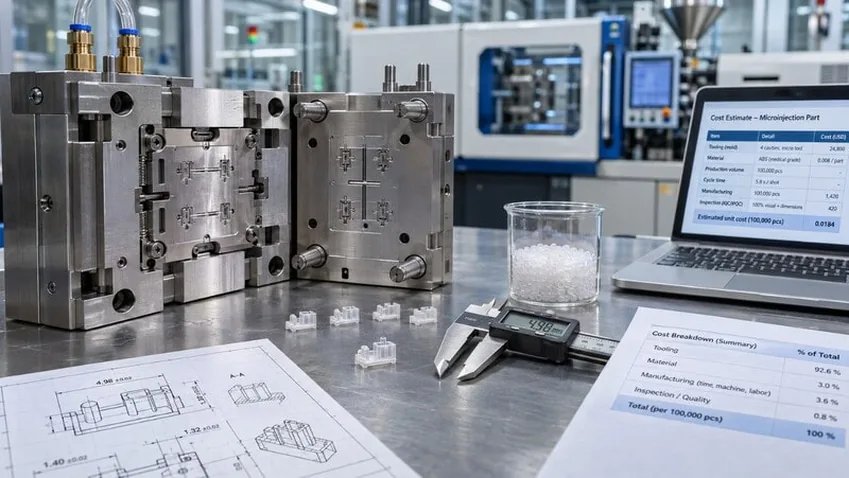
The finished part’s weight is not the same as the amount of material consumed. Runners, startup material, and potential scrap also need to be considered. A very small part is not necessarily inexpensive if it requires delicate handling or inspection. Our guide to plastic micro injection molding explores that particular case.
4. Part Geometry and Ease of Manufacturing
Part design affects both the mold and recurring production costs. An unnecessarily thick wall uses more material and may require additional cooling time before the part can be ejected. On the other hand, reducing wall thickness without considering mold filling or part strength can also make production more difficult.
Undercuts or surfaces that are difficult to release from the mold may require additional solutions. Changing those features after the mold has been built can mean modifications and further testing.
That is why evaluating manufacturability before committing to tooling is valuable, provided the part’s intended function is maintained. Our article on design for manufacturing (DFM) explores these considerations in greater detail.
5. Cycle Time and the Required Machine
Cycle time includes filling the mold, cooling the part, opening the mold, and ejecting the finished component. Longer cycle times mean fewer production cycles per hour, which can reduce overall output.
However, cost cannot be determined from cycle time alone. The number of active cavities, the number of acceptable parts, and any operations that limit output also matter. Ejecting a part before it is stable, for example, could increase rejection rates. What matters is not simply how fast the machine cycles, but how many acceptable parts it can consistently produce.
The molding machine must be compatible with the mold, the filling requirements, and the necessary clamping force. A lightweight part does not always call for the smallest machine. Buyers do not need to calculate machine tonnage themselves, but they should understand that equipment selection affects the manufacturing approach and its cost.
6. Tolerances, Surface Finish, and Quality Requirements
Two parts with the same shape can have different prices if one requires tighter dimensional tolerances, a particular cosmetic finish, or additional evidence of quality.
Dimensional tolerances define allowable variation. Tighter requirements can make manufacturing, process control, and measurement more demanding. A practical approach is to identify the dimensions that are critical to function, safety, or assembly rather than applying the same level of precision to every surface when it is not needed.
A visible surface may also require a particular texture, finish, or stricter acceptance criteria. Testing, records, approval samples, and traceability can add upfront or recurring activities. These requirements should reflect the part’s actual application and be accounted for in the quote.
7. Secondary Operations and the Level of Automation
Manufacturing does not always end when a part comes out of the mold. A component may need to be assembled with another part, fitted with an insert, marked or decorated, machined further, tested, or packaged individually.
Each operation can require its own tooling, consumables, labor, time, and acceptance criteria. A quote for molded parts is not equivalent to a quote for completed subassemblies.
Automation changes this calculation. An automated handling or inspection system may increase the upfront investment while reducing certain manual interventions during production. Whether it makes sense depends on volume, required repeatability, and how frequently the product changes. Neither avoiding automation nor implementing it guarantees the lowest price.
Total Project Cost: Why the Lowest Unit Price Is Not Always the Best Option
Consider two proposals to manufacture the same component to the same specification. The first requires a smaller upfront investment but uses a production approach with higher recurring costs. The second requires a greater tooling investment but may produce each part using fewer resources.
For low or uncertain demand, the first option may make more sense. For a long-running production program, the second deserves closer evaluation. There is no universal break-even point.
The comparison must also include what happens beyond the molding machine: maintenance, repairs, possible engineering changes, packaging, transportation, and delivery responsibilities. An existing mold must also be evaluated for condition, compatibility, and ownership. Our guide to transferring plastic part production takes a closer look at that situation.
Two quotes may differ in material selection, cavity count, acceptance criteria, production run sizes, or scope. Before choosing based on price, buyers should compare what their company will actually receive and the assumptions behind each offer. It is also important to establish which costs are included, which are excluded, and who is responsible for potential maintenance expenses or specification changes.
What Information Is Needed for a Reliable Price Estimate?
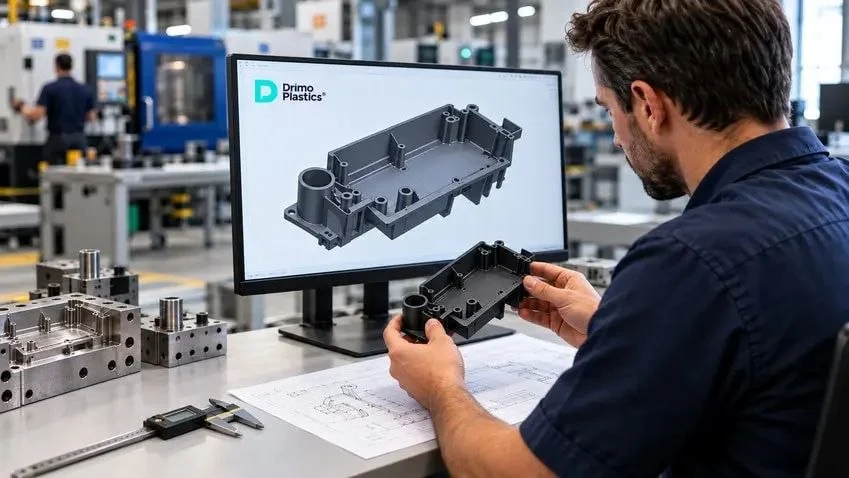
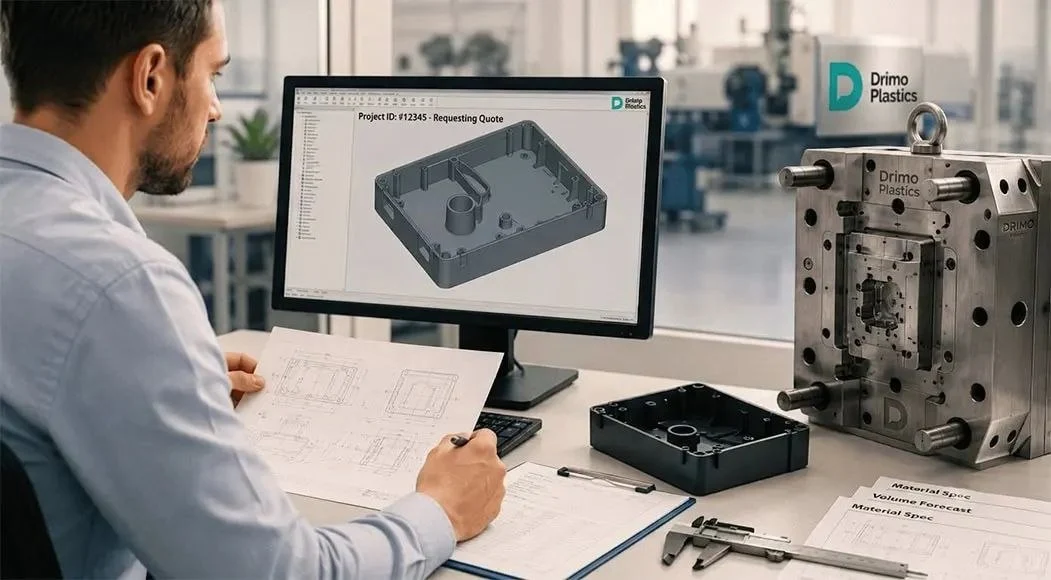
The evaluation starts with the part and its intended application. A CAD model or technical drawing helps, but a physical sample or reference can be enough to begin. The less defined the project is, the more uncertainty any estimate will carry.
It is also useful to share the specified material—or the conditions the part needs to withstand—along with order quantities, projected demand, and the expected duration of the program. Critical requirements for quality, appearance, assembly, packaging, and delivery complete the economic picture.
This information allows the manufacturer to evaluate alternatives before preparing a proposal. For help gathering the necessary documentation, see our guide to requesting a plastic injection molding quote.
Mold and material selection should account for both the part being produced today and future production needs.
At DRIMO Plastics, we help customers choose the appropriate type of mold based on initial production quantities, projected growth, and expected long-term demand. Selecting tooling without that perspective can increase manufacturing costs or require a second investment if production volumes grow.
We also help customers evaluate resin options. Sometimes a customer specifies a material that is difficult to source in Mexico or has properties that exceed the needs of the application. Before recommending a change, we assess potential alternatives in light of the required performance, quality, and material availability.
Frequently Asked Questions About Injection Molding Cost
Can I estimate the cost without a finalized CAD design?
Yes. A sample, reference, or concept is enough to begin an evaluation. A reliable quote, however, requires a clearer definition of the geometry, material, production volume, and acceptance criteria.
Does using an existing mold eliminate the upfront investment?
Not necessarily. Its condition, ownership, and compatibility must be checked. Modifications, maintenance, or validation may still be required.
Can the price per part change if the production volume or material changes?
Yes. Changes in demand can affect production run sizes and the manufacturing approach, while a different material may require new processing conditions or validation. The impact depends on the scope of the change.